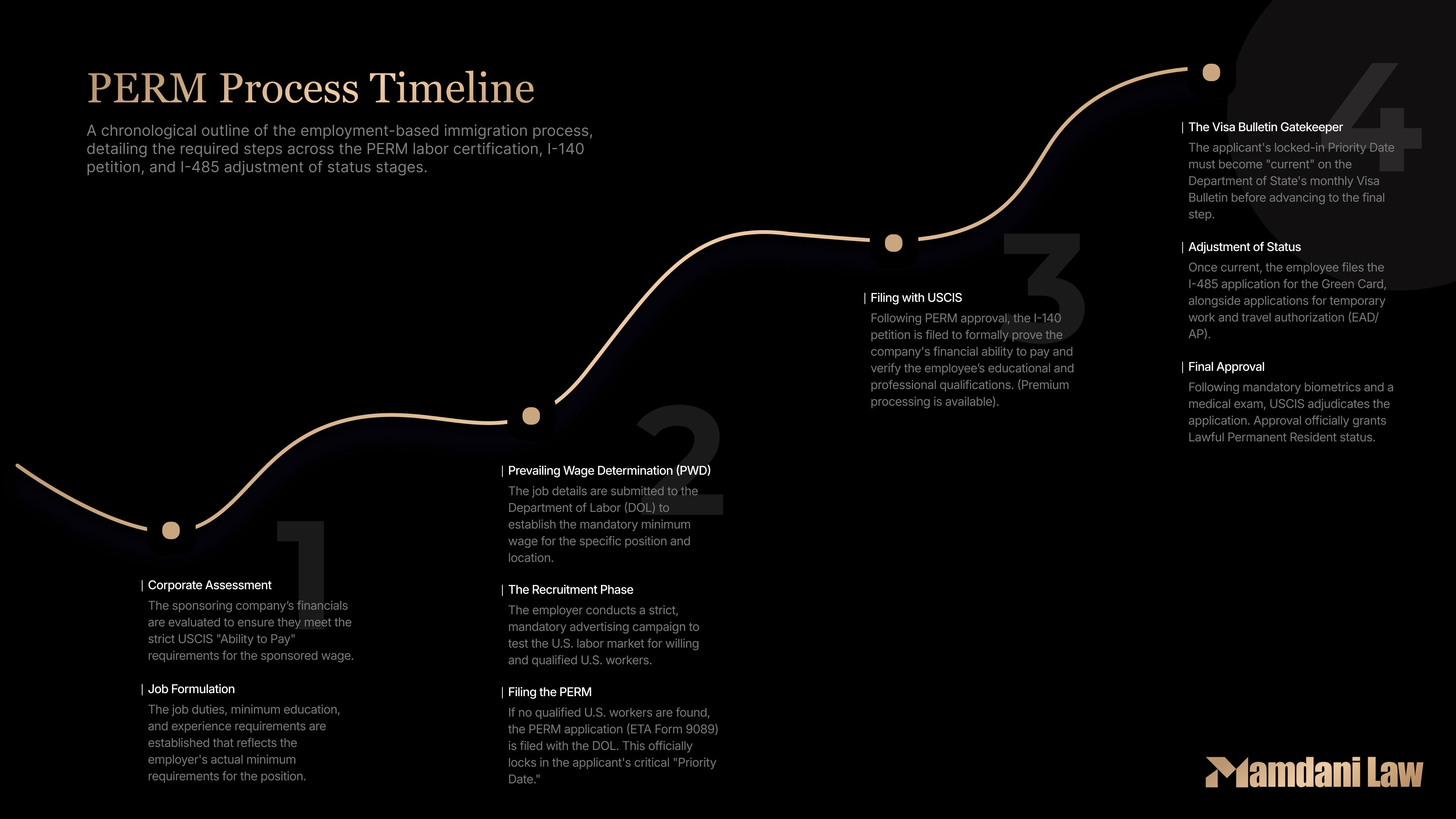
Introduction
Securing permanent residency (a "Green Card") for key foreign talent is a critical strategy for U.S. employers facing specialized labor shortages. For most employment-based categories (specifically EB-2 and EB-3), this journey begins with the PERM Labor Certification process.
Administered by the Department of Labor (DOL), the PERM process is designed with one primary goal: to protect the U.S. labor market. Before a foreign national can be sponsored for a Green Card, the employer must definitively prove that there are no willing, qualified, and available U.S. workers for the position.
The process is highly regulated and strict. Here is a step-by-step guide to understanding the PERM timeline.
Phase 1: Case Strategy and the Prevailing Wage Determination (PWD)
The foundation of a successful PERM application relies on accurately defining the job. We work closely with the sponsoring employer to detail the job duties and establish the absolute minimum education and experience requirements necessary to perform the role. These requirements cannot be tailored to the foreign national's specific resume; they must reflect the actual baseline needs of the position.
Once the job is formulated, we submit a request for a Prevailing Wage Determination (PWD) to the DOL. The DOL will assign a minimum wage that the employer must promise to pay the foreign worker upon the eventual approval of the Green Card.
Phase 2: Good Faith Recruitment
Once the PWD is issued, the employer must conduct a rigorous, legally mandated recruitment campaign to test the U.S. labor market. This is not a standard corporate hiring process; it is a highly specific compliance exercise.
For professional positions, the mandatory steps include:
Placing a job order with the State Workforce Agency.
Publishing advertisements in a Sunday newspaper of general circulation on two different Sundays.
Posting a physical Notice of Filing (NOF) at the worksite for 10 consecutive business days.
Selecting three additional recruitment methods (e.g., the employer's website, an employer-sponsored job fair, a job search website, etc.).
If no qualified U.S. workers are found, the employer must wait through a mandatory 30-day "quiet period" to allow any final resumes to arrive.
Phase 3: Filing the ETA Form 9089
Following a successful recruitment phase, we file the PERM application (ETA Form 9089) electronically with the DOL.
The date this application is received becomes the foreign national's Priority Date, essentially their place in line for a Green Card. The DOL will then process the application. It is important to note that the DOL can randomly, or purposefully, select applications for an Audit. If audited, the employer must provide all recruitment documentation to prove compliance, which extends the processing time.
Phase 4: The I-140 Immigrant Petition
Upon DOL certification of the PERM, the employer files the Form I-140 petition with U.S. Citizenship and Immigration Services (USCIS). This step shifts the focus from the labor market to the specifics of the company and the employee.
USCIS will rigorously review two main factors:
The Employer's Finances: Proof that the company has the ability to pay the prevailing wage.
The Employee's Qualifications: Proof that the foreign national possesses all required education and experience.
Premium processing is generally available for this step.
Phase 5: The Green Card Application
The final step is the actual application for permanent residency. The employee cannot take this step until their Priority Date becomes "current" according to the State Department's monthly Visa Bulletin.
If the employee is already in the U.S. in a valid nonimmigrant status (like an H-1B), they will file an I-485 Adjustment of Status application. If they are outside the U.S., they will undergo Consular Processing at a U.S. embassy. (Note: If the Priority Date is current at the time of the PERM approval, the I-140 and the I-485 can be filed simultaneously).