No headings found on page
What the L-1A visa is, who it is for, and its legal basis
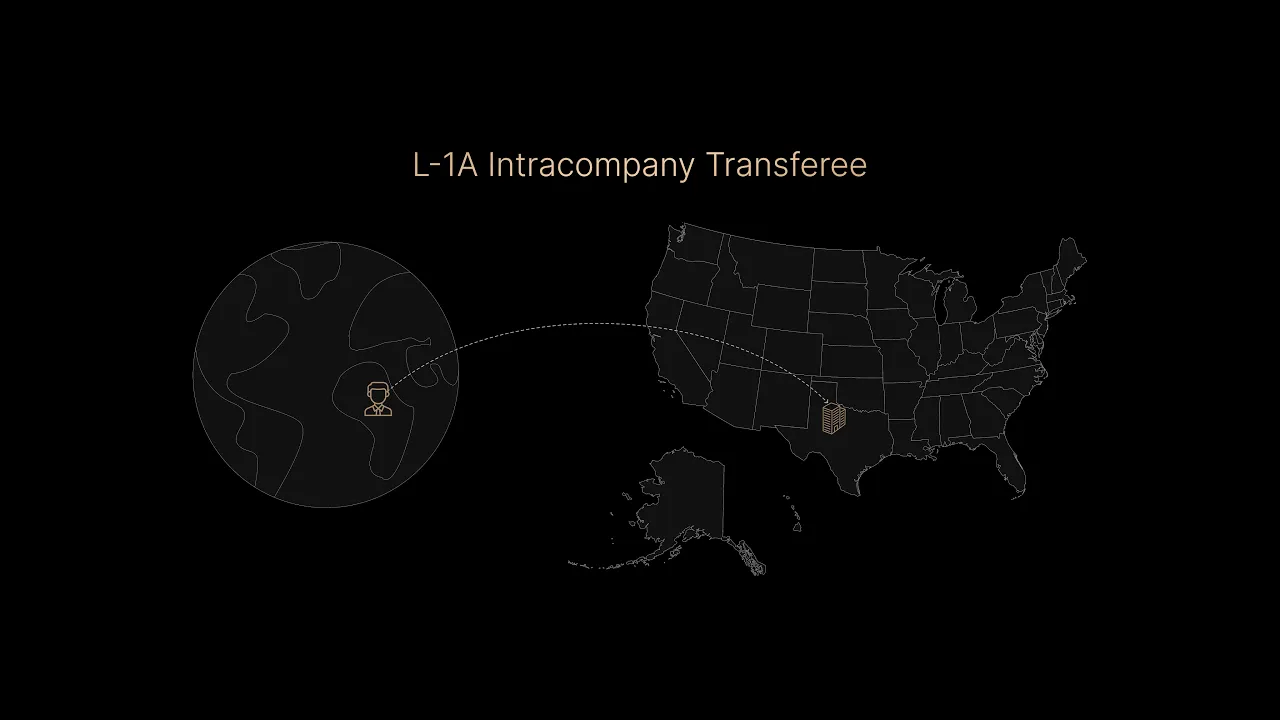
The L-1A is for an executive or manager who has worked for a company abroad and is being transferred to a related company in the United States. It is built for multinational businesses moving leadership into a U.S. operation, and it is one of the main tools a foreign company uses to open and staff a new U.S. office. There is no annual cap, no lottery, and no labor certification.
Several features make it valuable. It is a dual-intent category, so pursuing a green card (usually through the closely matching EB-1C category) does not put the status at risk. The spouse can work. And it can be renewed up to a seven-year maximum. The main limits are that it ties the worker to the qualifying corporate group, the managerial or executive nature of the role is heavily scrutinized, and the seven-year cap eventually forces either a move to permanent residence or time spent abroad. The related option for employees with specialized knowledge rather than a managerial or executive role is the L-1B visa.
The legal basis sits at several levels. The statute is the Immigration and Nationality Act at section 101(a)(15)(L), codified at 8 U.S.C. 1101(a)(15)(L); the definitions of managerial and executive capacity are at section 101(a)(44), 8 U.S.C. 1101(a)(44). The regulations are at 8 CFR 214.2(l), and the Department of State’s adjudication guidance for consular cases is in the Foreign Affairs Manual at 9 FAM 402.12.
Do you qualify: the core requirements
Four building blocks have to be in place, and each one must be documented.
A qualifying corporate relationship. The U.S. employer and the foreign employer must have a qualifying relationship as a parent, branch, subsidiary, or affiliate. Both must be doing business as employers in the United States and at least one other country for the whole time the person holds L-1A status. The ownership and control linking the two entities has to be proven, which can be involved when it runs through holding companies or multiple shareholders.
One year of qualifying employment abroad. The employee must have worked for the qualifying organization abroad full time and continuously for at least one year within the three years before coming to the United States, in a managerial, executive, or specialized-knowledge capacity. Time already spent working inside the United States for the company does not count toward the year, although it does not break the continuity.
A managerial or executive role in the United States. For the L-1A specifically, the position in the United States must be managerial or executive. What that means in practice is the most important part of the case and has its own section below.
Doing business. Both entities must be doing business, meaning the regular, systematic, and continuous provision of goods or services. The mere presence of an agent or an office, without real ongoing activity, is not enough.
Managerial and executive capacity (what USCIS looks for)
This is the heart of an L-1A and the most common reason cases are questioned or denied. The titles matter far less than what the person actually does.
Managerial capacity. Under the statute, a manager primarily manages the organization or a department, subdivision, function, or component; supervises and controls the work of other supervisory, professional, or managerial employees, or instead manages an essential function; has authority over personnel actions such as hiring and firing (or, where no one is directly supervised, operates at a senior level with respect to the function managed); and exercises discretion over day-to-day operations. A first-line supervisor is not a manager just because they supervise people, unless the people supervised are professionals. The category that confuses many applicants is the function manager, who manages an essential function rather than a team of people; that is allowed, but it must be documented carefully, showing the function, the seniority of the role, and who handles the routine work.
Executive capacity. An executive primarily directs the management of the organization or a major component or function, establishes goals and policies, exercises wide latitude in discretionary decision-making, and receives only general supervision from higher executives, the board, or stockholders.
A note on small and new companies. A small or recently opened company can qualify, and the law requires USCIS to take into account the reasonable needs of the organization given its stage of development. But the company still needs a structure that genuinely supports an executive or manager, which usually means other staff or contractors to do the operational work, so the transferee is managing or directing rather than personally performing all the day-to-day tasks. A one-person operation rarely supports an L-1A.
New offices and blanket L petitions
Two situations have their own rules.
Opening a new U.S. office. When the L-1A is used to launch a U.S. office that has been doing business for less than a year, the first petition is approved for only one year. To get that initial year, the petition must show that sufficient physical premises have been secured, that the employee worked abroad in a qualifying managerial or executive capacity for the required year, and that the new operation will be able to support an executive or managerial position within one year, backed by a business plan, the size of the investment, the company’s financial ability, and the planned organizational structure. Before the year ends, the company files an extension showing the office has actually been doing business, describing the staffing and the transferee’s duties, and demonstrating that the role is now genuinely managerial or executive. New-office extensions are scrutinized closely, and a thinly staffed office that has not grown as projected is a frequent denial point.
The blanket L petition. Large, established multinationals can file a blanket L petition to avoid filing a separate petition for every transfer. A company generally qualifies if it has a U.S. office that has been doing business for at least a year, has at least three branches, subsidiaries, or affiliates, and meets one of several size thresholds (for example, a track record of L approvals, combined U.S. sales of at least $25 million, or a U.S. workforce of at least 1,000 employees). Once the blanket is approved, a qualifying executive or manager can take the blanket approval and Form I-129S directly to a U.S. consulate for the visa, which is much faster for companies that move people frequently.
How to apply, and how long L-1A lasts
There are a few routes, depending on the company and the worker’s location.
The individual petition. The U.S. employer files Form I-129 with the L Classification Supplement (plus the new-office evidence if applicable). If the worker is abroad, they then apply for the L-1 visa at a U.S. consulate using Form DS-160and enter on it. If the worker is already in the United States in a valid status, the petition can request a change of status, and an existing L-1A is renewed through an extension of stay. As with other petition-based categories, a change of status grants L-1A status but not a visa, so any later international travel requires getting an L-1 visa at a consulate first, and the underlying status has to be kept valid throughout, a point covered in maintaining status and visa stamping.
The blanket route. Where an approved blanket exists, the worker uses Form I-129S with the blanket approval to apply for the visa at a consulate, without a separate individual petition.
Canadian citizens. Because Canadians are visa-exempt, a Canadian L-1A applicant can present the petition (or, under a blanket, Form I-129S) at a port of entry or pre-clearance and be processed there.
How long it lasts. The initial stay is up to three years, or one year for a new office. Extensions are granted in increments of up to two years. The maximum for L-1A is seven years. After reaching the limit, the person generally must spend a full year outside the United States before a new L petition, which is one reason many executives and managers move toward a green card well before year seven.
Fees and processing time
Government fees (current as of mid-2026). On the USCIS side, the employer pays:
Form I-129 base filing fee: $1,385, reduced to $695 for a small employer with 25 or fewer full-time-equivalent employees or a nonprofit. This applies to both the initial petition and each extension.
Asylum Program Fee: $600, reduced to $300 for small employers and $0 for nonprofits, also on initial petitions and extensions.
Fraud Prevention and Detection Fee: $500, but only on an initial L-1 petition or when changing employers, not on an extension with the same employer.
Public Law 114-113 fee: $4,500, which applies only to employers that have more than 50 employees in the United States with more than half of them in H-1B or L-1 status, and only on initial petitions and changes, not extensions.
Optional premium processing (Form I-907) is $2,965 for a decision within 15 business days.
On the consular side, the visa application (MRV) fee is $205 per applicant, plus any reciprocity fee, which varies by country. Separately, a new $250 Visa Integrity Fee enacted in 2025 will apply to most nonimmigrant visas, charged at the time the visa is issued and including each dependent; as of mid-2026 the government has not yet begun collecting it, but applicants should budget for it once it goes live. All of these are government fees; attorney fees are separate.
Processing time. A regular Form I-129 generally takes several months; premium processing shortens the USCIS decision to 15 business days but does not speed up a later consular visa, which varies by post.
Your spouse and children
The L-1A holder’s spouse and unmarried children under 21 can hold L-2 dependent status. The spouse can work: since late 2021, L-2 spouses are employment authorized incident to their status and are issued a Form I-94 marked L-2S, and an unexpired I-94 with that code is itself acceptable proof of work authorization, so the spouse does not need a separate Employment Authorization Document to take a job (though one may be obtained optionally, and the spouse can work for any employer). The details are in our article on H-4 and L-2 work authorization. Children in L-2 status may attend school but cannot work, and a child who turns 21 ages out of dependent status and needs a separate status. More on derivative status is in our article on dependents of work visa holders.
Common pitfalls, denials, and the green-card path
Common pitfalls. Most L-1A problems come from a few places: a U.S. role that reads like a first-line supervisor or a hands-on doer rather than a true manager or executive; a function-manager claim that is not well documented; weak proof of the qualifying relationship between the two companies; a new office that is under-resourced or has not grown enough to support a manager or executive by the one-year extension; a foreign-employment year that has gaps, was part time, was with the wrong entity, or falls outside the three-year window; and confusing the managerial or executive standard of the L-1A with the specialized-knowledge standard of the L-1B. Small companies draw extra questions about who the person will actually manage. And, as with any petition-based category, a change of status does not provide a travel visa.
If your case is denied. The route forward depends on where the decision was made. A denial of the Form I-129 by USCIS can be challenged by an appeal to the Administrative Appeals Office or by a motion to reopen or reconsider, filed on Form I-290B within 30 days (33 if mailed); the AAO reviews the case fresh. One nuance: if USCIS approves the underlying petition but denies only the change of status or extension of stay, a motion is available but an appeal is not. Refiling a stronger petition is often the most practical option, and in some cases a federal court challenge under the Administrative Procedure Act is appropriate. A consular refusal is different: a refusal under section 214(b) cannot be appealed and is addressed by reapplying with a stronger case, while a refusal under section 221(g) usually means more documents or administrative processing, as discussed in visa refusals.
The green-card path. The L-1A has a natural immigrant counterpart in the EB-1C category for multinational managers and executives, which uses a similar managerial or executive standard and, importantly, does not require labor certification (PERM). Because the L-1A is dual intent, an executive or manager can pursue EB-1C while holding L-1A status without jeopardizing it, and many do so before reaching the seven-year limit. EB-1C and the other immigrant options are surveyed in our employment-based green cards overview, and recent guidance has made the choice between adjusting status in the United States and processing a visa abroad more consequential, as explained in adjustment of status and USCIS discretion.
Sources and further reading
These are the official, government sources behind this article. Fees and rules change, so confirm current details on these pages before relying on them.
Immigration and Nationality Act, section 101(a)(15)(L), 8 U.S.C. 1101(a)(15)(L): https://uscode.house.gov/view.xhtml?req=granuleid:USC-prelim-title8-section1101
Immigration and Nationality Act, section 101(a)(44) (managerial and executive capacity), 8 U.S.C. 1101(a)(44): https://uscode.house.gov/view.xhtml?req=granuleid:USC-prelim-title8-section1101
Title 8, Code of Federal Regulations, section 214.2(l) (L-1 classification, new office, and blanket rules): https://www.ecfr.gov/current/title-8/part-214/section-214.2
Foreign Affairs Manual, 9 FAM 402.12 (intracompany transferees): https://fam.state.gov/
USCIS, L-1A Intracompany Transferee Executive or Manager: https://www.uscis.gov/working-in-the-united-states/temporary-workers/l-1a-intracompany-transferee-executive-or-manager
USCIS, Form I-129, Petition for a Nonimmigrant Worker (including where to file): https://www.uscis.gov/i-129
USCIS, Form I-907, Request for Premium Processing Service: https://www.uscis.gov/i-907
USCIS fee information and fee schedule: https://www.uscis.gov/forms/filing-fees
USCIS, Form I-290B, Notice of Appeal or Motion (and what may be appealed): https://www.uscis.gov/i-290b
U.S. Department of State, work visas and the visa application process: https://travel.state.gov/content/travel/en/us-visas/employment.html
Important note. This article is general legal information for educational purposes, not legal advice, and reading it does not create an attorney-client relationship. L-1A eligibility, fees, and processing rules change and depend heavily on the facts of a particular company and employee, including the corporate structure and the employee’s role and history. The figures and rules here are current as of mid-2026 and should be confirmed against the official sources above. For advice about a specific L-1 matter, consult a qualified immigration attorney.